The 9 F1 champions who'd lose their title under today's points system
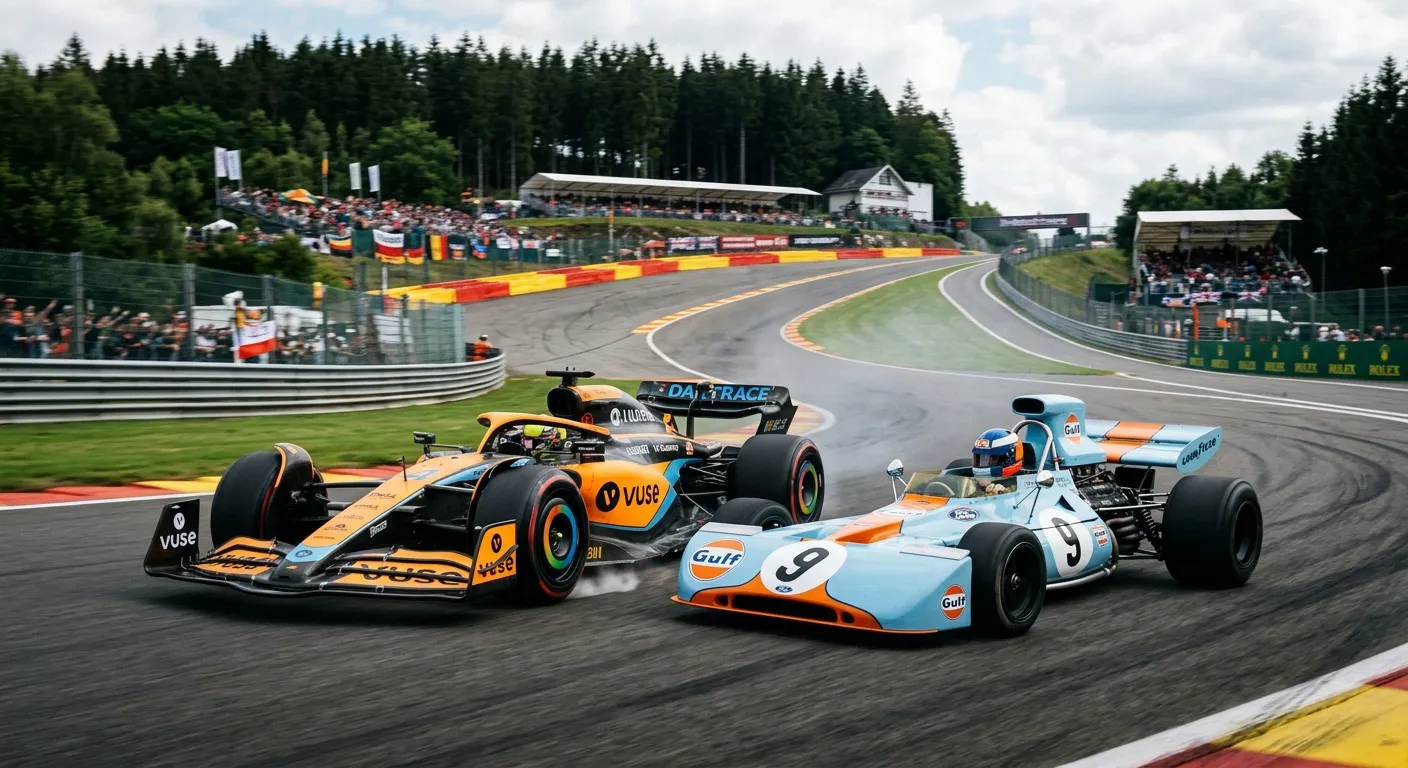
One trophy, a dozen different rulebooks
The points system that decides the Formula 1 World Championship is not a law of nature. It has been rewritten more than a dozen times since 1950: eight points for a win, then nine, then ten, now twenty-five. For decades only your best few results counted and the rest were thrown away. There were half-points races, a fastest-lap bonus that came and went, and seasons where finishing second every single weekend was worth more than winning half the races.
So a natural question: how much of the record book is a product of the rulebook rather than the racing?
To find out, I replayed every World Championship since 1950 under the points system F1 uses today, counting how often the name on the trophy changes.
Methodology
For every race in the database I awarded points on the current scale:
Finish | Points |
|---|---|
1st | 25 |
2nd | 18 |
3rd | 15 |
4th | 12 |
5th | 10 |
6th | 8 |
7th | 6 |
8th | 4 |
9th | 2 |
10th | 1 |
Then I summed every driver’s points across each season, counting every race, with no dropped scores, and picked the driver with the most as that season’s champion.
A few deliberate simplifications are worth stating up front, because they are exactly the things that make the old results differ from the new ones:
- Every result counts. The single biggest change. For most of F1’s first four decades, only a driver’s best N finishes counted toward the title. Modern F1 counts everything, and so do I.
- No half points, no fastest-lap bonus, no sprint points. Just the race classification on the modern scale. This keeps every era comparable.
- Points on the road only. The recompute can’t see disqualifications, bans, or penalties applied to the standings. It only knows where cars finished. That matters for one season in particular (1997).
- Drivers obviously raced to the rules of their day. Nobody was managing a 25-point win in 1965. This is a thought experiment about the scoring, not a claim that history was “wrong.”
Across 76 completed championships (1950–2025), the recompute agrees with the record books 67 times. Here are the nine it doesn’t.
The nine flips
Season | Real champion | Champion under today’s rules | Revised pts | Ahead by | Why it flips |
|---|---|---|---|---|---|
| 1964 | John Surtees | Graham Hill | 126 | 7 | |
| 1965 | Jim Clark | Graham Hill | 153 | 2 | |
| 1976 | James Hunt | Niki Lauda | 207 | 1 | |
| 1983 | Nelson Piquet | Alain Prost | 185 | 2 | |
| 1984 | Niki Lauda | Alain Prost | 227 | 16 | |
| 1988 | Ayrton Senna | Alain Prost | 301 | 26 | |
| 1994 | Michael Schumacher | Damon Hill | 252 | 16 | |
| 1997 | Jacques Villeneuve | Michael Schumacher | 229 | 7 | |
| 1999 | Mika Häkkinen | Eddie Irvine | 237 | 21 |
The dropped-scores era
Notice that seven of the nine flips happen before 1995, and that is no accident. The single most consequential rule F1 ever ran was dropped scores: for most seasons up to 1990, only a driver’s best handful of results counted toward the championship. Consistency beyond that threshold was worthless.
The purest example is 1988. McLaren’s pairing of Senna and Prost won fifteen of the sixteen races. Prost actually scored more points on the road all season, but because only each driver’s best eleven results counted, Prost’s surplus podiums were simply thrown in the bin. Senna’s eight wins beat Prost’s seven where it mattered, and Senna took the title. Remove the cap, as modern F1 has, and Prost wins by 26.
1965 is the mirror image, and the flip I trust least. Jim Clark won six of ten races in a season so dominant it feels absurd to hand the title to anyone else. But Clark retired from most of the races he didn’t win, and under the best-six rule those retirements cost him nothing. Add up every result and Graham Hill’s habit of finishing second and third quietly out-totals Clark by two points. A reminder that “count everything” is a genuinely different philosophy of what a champion is, and not obviously a fairer one.
Half a point, one point, one collision
Three of the flips were decided in reality by almost nothing at all, and the modern scale is just big enough to tip them the other way:
- 1984 remains the closest championship ever: Niki Lauda beat his McLaren teammate Prost by half a point, a margin that only exists because the Monaco GP was stopped early in the rain and paid half points. Modern rules don’t do halves, and reward Prost’s seven wins over Lauda’s five.
- 1976, immortalised by Rush, came down to a single point in Hunt’s favour after Lauda’s fiery crash and the two races it cost him. Flip to the modern scale and that one point goes back to Lauda.
- 1994 was settled when Schumacher and Hill collided at the final round in Adelaide, Schumacher a point ahead. But that season Schumacher was also banned for two races and disqualified from others; give him no penalty and count everything, and Hill was the more prolific scorer.
Where the maths breaks: 1997
1997 is the one flip that reality deliberately overturned. Michael Schumacher genuinely outscored Jacques Villeneuve on track that year, with our recompute putting him seven points clear. But at the title-deciding Spanish round he turned into Villeneuve’s Ferrari in a failed attempt to take them both out, and the FIA responded by striking him from the entire championship. A points-only model has no way of seeing that, so it dutifully hands Schumacher a title the sport took away from him. It’s a useful reminder of what a bare scoreboard can and can’t tell you.
The revised roll of honour
Play it all out and the record book shifts in some tidy ways:
- Alain Prost is the biggest winner. Already a four-time champion, he collects 1983, 1984 and 1988 to become a seven-time World Champion, level with Schumacher and Hamilton.
- Graham Hill climbs from two titles to four.
- Eddie Irvine, who never came closer than runner-up in real life, becomes a world champion (1999).
- Two greats simply swap which years they won without changing their tally: Niki Lauda loses 1984 but gains 1976 (still three, and now three in a row), and Michael Schumacher loses 1994 but gains 1997 (still seven).
- The unlucky ones: Surtees, Hunt and Villeneuve each drop from champion to zero titles, while Clark, Piquet, Senna and Häkkinen each lose one.
None of this means the history books are wrong. Every one of these drivers won fair and square under the rules they were handed. But it does show how much a championship is shaped by the scoring, not just the driving. Change the arithmetic and roughly one title in eight lands on a different mantelpiece.
Other ways to look into this
A stricter version would keep each era’s dropped-scores rule and only swap the points values, which alone would save Senna’s 1988 and Clark’s 1965. Another would layer in sprint points, half points and the fastest-lap bonus to see whether any modern championship (2003 onwards) is sensitive to the scale. So far, none of them flip. The recent title fights were close on any rulebook you choose.